Battery Tie-Down Kit Degraded By Electrolyte
I recently installed a Victron SmartShunt, and a pair of Blue Sea 7701 power relays, to take over the function of the Perko rotating battery bank selector. (I wired them in parallel, leaving the Perko as a backup.)
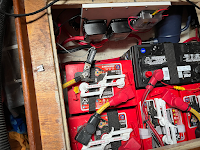 As one might well imagine, to accomplish this I had to remove one of the batteries in my house bank... which led to an alarming discovery, which in turn led to a rather shocking discovery. Alarmingly, my charger voltage was set too high (left by the previous owner) it was boiling electrolyte out of my batteries. This was, of course, easily corrected.


Of course this discovery compelled me to pull them all. I replaced the pad eyes with 316 stainless ones, and used plastic buckles to create the loops. (Note: further research indicates that 316 SS is not the best material either.)
The old plastic stuff came from a kit, sold by marine stores specifically for securing marine batteries, installed by my boatyard. Clearly the choice of materials was a poor one! (It's not like there aren't plenty of plastics that will withstand sulfuric acid.) It is well understood that lead-acid batteries sometimes lose some electrolyte, yet these straps fail completely and catastrophically if that not-uncommon condition occurs! Manufacturing something so unsuitable for its intended purpose is unconscionable -- it puts lives at risk!

Boaters with any reason to suspect any electrolyte has spilled, that these inferior tie-downs are installed, or any other condition that might compromise the hardware used to secure batteries, should take the time to pull them out of the box for a thorough inspection, to check the integrity of both the pad eyes and the straps.
I wish I could say specifically what brand the inferior parts were, but I can't, they were installed by my yard over 2 years ago. That information would add a great deal of relevance to this article, but it is unavailable.
I'm not sure where responsibility properly lies to test these sorts of things. In today's world, where knock-offs abound, it is clearly not enough to trust the makers. Unfortunately, it is the end consumers, us mariners, who's lives are on the line.
After reaching out to both vendors and makers, I've decided to DIY (sad fucking state of affairs, isn't it?) King Starboard is a trade name for HDPE, I've milled the pad eyes out of that. I used 1" polypropylene webbed strap rated at 600 lbs, two straps per battery. And I stitched up the loops on one end of each strap with braided polyethylene fishing line, 50 lb. test.
The best polypropylene buckles I could find are rated at 150 lbs. -- which does exceed ABYC spec by more than 20%, but, as mentioned above, I allowed room for 2 straps each (and I could also add a double half-hitch after the buckle, that would only be loaded if the buckle fails.)
I tested them at almost 2x the load required by ABYC and for at least 4x the duration... full details and pictures of the installation in another post..
3D model of pad eye
Comments
Post a Comment